






- Introduction: The Art of Balance – Mind, Body, and Spirit in Asia
- Foundations of Balance: Philosophy and Culture
- Mind: Cultivating Clarity Through Meditation and Mindfulness
- Body: Movement as Medicine – Yoga, Tai Chi, and Qigong
- Spirit: Ritual, Nature, and Inner Stillness
- Regional Wisdom: A Pan-Asian Perspective
- Modern Life, Ancient Wisdom: Integrating Balance Today
- Conclusion: Embracing Wholeness in Daily Life
- Frequently Asked Questions (FAQ)
Introduction: The Art of Balance – Mind, Body, and Spirit in Asia
There’s a quiet moment in Kyoto’s morning mist when a monk rings the temple bell—once, twice—its deep tone vibrating through the still air. In that hush, something shifts. The mind quiets. The breath deepens. The body settles. It’s not magic. It’s not mysticism. It’s balance—a rhythm cultivated for centuries across Asia, where wellness isn’t a trend, but a way of life.
Across mountains, monasteries, rice paddies, and city streets, mind body spirit balance practices in Asia have shaped cultures, healing systems, and daily rituals. These traditions aren’t about perfection. They’re about presence. About aligning your thoughts, movements, and soul in a way that feels sustainable, sacred, and deeply human.
In a world that glorifies hustle, burnout, and endless scrolling, the Eastern approach to well-being offers a gentle but powerful alternative: slowness with purpose. This is not just self-care—it’s self-remembering.
Let’s journey together through the heart of Asia’s wisdom, where balance isn’t found in extremes, but in the art of harmony.
Foundations of Balance: Philosophy and Culture
To understand mind body spirit balance practices in Asia, we must first step into the worldview that birthed them—one where health is not the absence of illness, but the presence of flow.
👉 “Curious about holistic wellness? Discover timeless wisdom in our guide on Ancient Ayurvedic healing practices for health.”
Unlike the Western medical model, which often treats symptoms in isolation, Asian traditions see the human being as an interconnected system. Think of it like a garden: if the soil is dry, the leaves wilt. If the roots are tangled, the flowers won’t bloom. In the same way, imbalance in one area—your thoughts, your posture, your emotions—ripples through the whole.
At the core of this philosophy are three major traditions:
- Taoism (China): Emphasizes wu wei—effortless action—and living in harmony with the Tao, or the natural flow of the universe.
- Buddhism (India, spreading across Asia): Teaches mindfulness, compassion, and liberation from suffering through awareness.
- Ayurveda (India): The world’s oldest holistic healing system, focusing on doshas (body-mind types) and seasonal rhythms.
These aren’t just belief systems. They’re blueprints for daily living. In Japan, ikigai—your reason for being—guides career, diet, and relationships. In Bali, every household has a family temple where offerings are made not to distant gods, but to the divine within and around.
At the heart of mind body spirit balance practices in Asia lies a simple truth: you are not separate from nature, from others, or from yourself. Healing begins when we stop fighting this connection and start nurturing it.
And so, balance isn’t something you achieve. It’s something you cultivate, moment by moment.
Mind: Cultivating Clarity Through Meditation and Mindfulness
The mind is both our greatest ally and our fiercest opponent. Left unchecked, it races with anxiety, replays the past, and fears the future. But in Asia, the mind is also seen as a garden—capable of peace, focus, and insight, with the right care.
👉 “Want to boost relaxation and overall health? Don’t miss our guide on Why Massage Therapy Is a Must for Your Wellness: The Ultimate Guide.”
One of the most profound aspects of mind body spirit balance practices in Asia is the cultivation of a disciplined, peaceful mind. This isn’t about emptying the mind—something many Westerners misunderstand. It’s about observing it, without judgment.
Take Vipassana meditation, rooted in ancient Indian Buddhist tradition. Practitioners sit in silence for 10 days, observing bodily sensations and mental patterns. No talking. No reading. No distractions. The goal? To see reality as it is—not filtered through desire or aversion.
Or consider Zen (Chan) Buddhism in Japan and China. Here, meditation (zazen) is done with eyes half-open, spine straight, breath steady. There’s no mantra, no visualization—just sitting. “Just sit,” as Zen masters say. In that simplicity lies profound clarity.
Then there’s loving-kindness (Metta) meditation, widely practiced in Thailand and Myanmar. You silently repeat phrases like:
“May I be happy. May I be safe. May I be healthy. May I live with ease.”
Then you extend it to others—first loved ones, then neutral people, even those you struggle with.
These practices aren’t reserved for monks. In cities like Seoul and Singapore, office workers attend “mindfulness cafés” during lunch breaks. In schools across Vietnam, children start the day with five minutes of breathing exercises.
From Zen monasteries to Vipassana retreats, mind body spirit balance practices in Asia emphasize sustained attention as a path to liberation. And the science agrees: regular meditation reduces cortisol, improves focus, and increases emotional resilience.
But here’s the secret the East has known for millennia: a calm mind isn’t the result of a quiet life—it’s the foundation of one.
Body: Movement as Medicine – Yoga, Tai Chi, and Qigong
In Asia, the body is not merely a vessel. It’s a dynamic field of energy—central to mind body spirit balance practices in Asia.
While the West often treats exercise as punishment or performance, Eastern traditions see movement as medicine, ritual, and prayer. The body isn’t something to be tamed. It’s something to be listened to.
Let’s explore three pillars of embodied balance:
Yoga (India): Union of Breath and Being
Born over 5,000 years ago in the Indus Valley, yoga is far more than downward dog and Instagram poses. The word yoga means “to yoke” or “unite”—mind, body, and spirit.
Traditional Hatha Yoga—still widely practiced in ashrams across Rishikesh and Kerala—combines physical postures (asanas), breath control (pranayama), and meditation. The goal? To prepare the body for stillness, so the mind can turn inward.
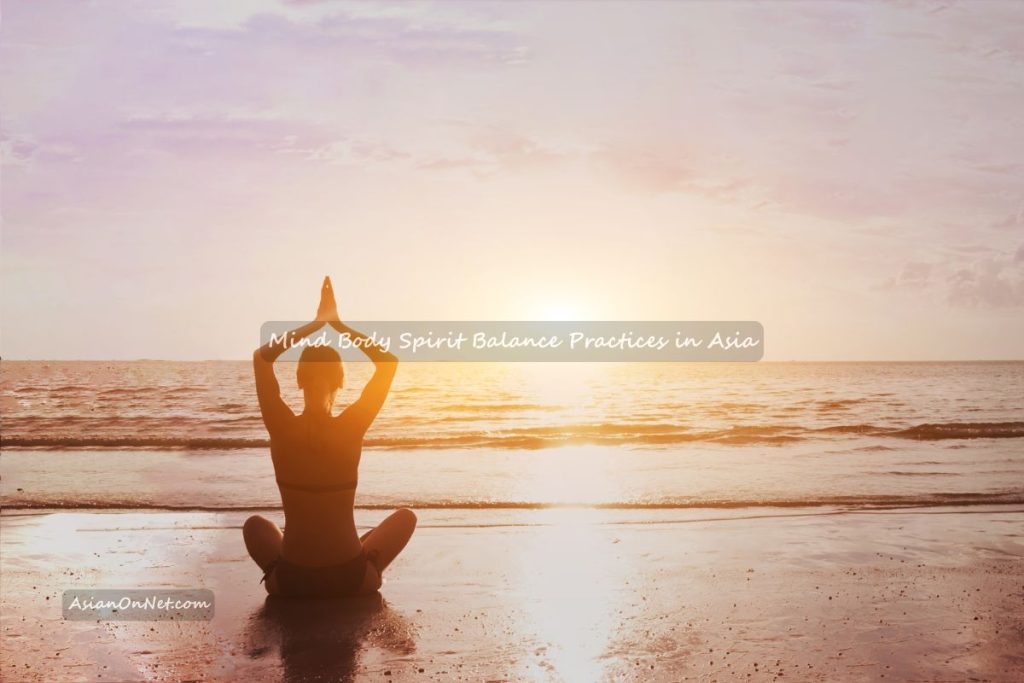
Even today, millions begin their day with Surya Namaskar (Sun Salutation)—a flowing sequence that warms the spine, clears the lungs, and awakens the senses.
Tai Chi (China): Meditation in Motion
Imagine slow, flowing movements—like a leaf drifting on water. That’s Tai Chi, a martial art turned healing practice.
Developed in ancient China, Tai Chi is based on Taoist principles of yin and yang, and the flow of qi (life energy). Each movement is deliberate, coordinated with breath, and designed to unblock stagnant energy.
Studies show Tai Chi improves balance, reduces arthritis pain, and lowers blood pressure. But more than that, it teaches grace under motion—a metaphor for life itself.
Qigong (China): Cultivating the Life Force
Closely related to Tai Chi, Qigong (“chee-gong”) means “energy cultivation.” It combines gentle movements, breathwork, and focused intention to circulate qi through the body’s meridians.
You’ll see elders in Beijing’s parks at dawn, arms rising and falling like waves, practicing Ba Duan Jin (“Eight Brocades”)—a classic Qigong form. It takes just 15 minutes, yet it’s said to strengthen organs, calm the mind, and boost immunity.
These flowing forms exemplify mind body spirit balance practices in Asia, where motion becomes meditation.
Whether through Hatha Yoga in India or Ba Duan Jin in China, these traditions reflect the depth and diversity of mind body spirit balance practices in Asia—not as workouts, but as moving prayers for wholeness.
Spirit: Ritual, Nature, and Inner Stillness
If the mind is clarity and the body is movement, the spirit is connection—to something greater than ourselves.
In the West, “spirituality” often gets reduced to religion or vague self-help. But in Asia, the spiritual dimension is woven into daily life—through ritual, nature, and silence.
The Sacred in the Ordinary
In Japan, the tea ceremony (chanoyu) isn’t just about drinking matcha. It’s a choreographed ritual of presence, humility, and beauty. Every gesture—from wiping the bowl to bowing—carries meaning. It’s mindfulness made visible.
In Bali, families place canang sari—small woven palm-leaf baskets filled with flowers, rice, and incense—on doorsteps, dashboards, and sidewalks every morning. These offerings honor the gods, ancestors, and the balance between positive and negative forces.
These aren’t “religious duties.” They’re acts of gratitude—reminders that life is sacred, even in its smallest moments.
Nature as Temple
In Shinto (Japan), mountains, rivers, and trees are inhabited by kami—spirits or divine energies. Forest bathing (shinrin-yoku) isn’t just a wellness trend; it’s a spiritual practice. Simply walking mindfully in the woods, breathing in phytoncides (natural oils from trees), lowers stress and boosts immunity.
In Bhutan, Gross National Happiness supersedes GDP. Over 70% of the country is forested, and development is measured by harmony with nature.
Even in crowded cities like Hong Kong, people hike on weekends—not just for exercise, but to recharge. Temples are built into cliffs. Pagodas rise from bamboo groves. Nature isn’t an escape. It’s home.
Inner Stillness: The Final Frontier
Spirit, in the Asian context, isn’t about believing in something unseen. It’s about feeling the unseen—the stillness beneath thoughts, the warmth beneath the ribs, the silence between heartbeats.
This is why monasteries across Asia—from Korean Seon temples to Nepalese Buddhist retreats—offer silent meditation retreats. No phones. No talking. No distractions. Just you, your breath, and the present moment.
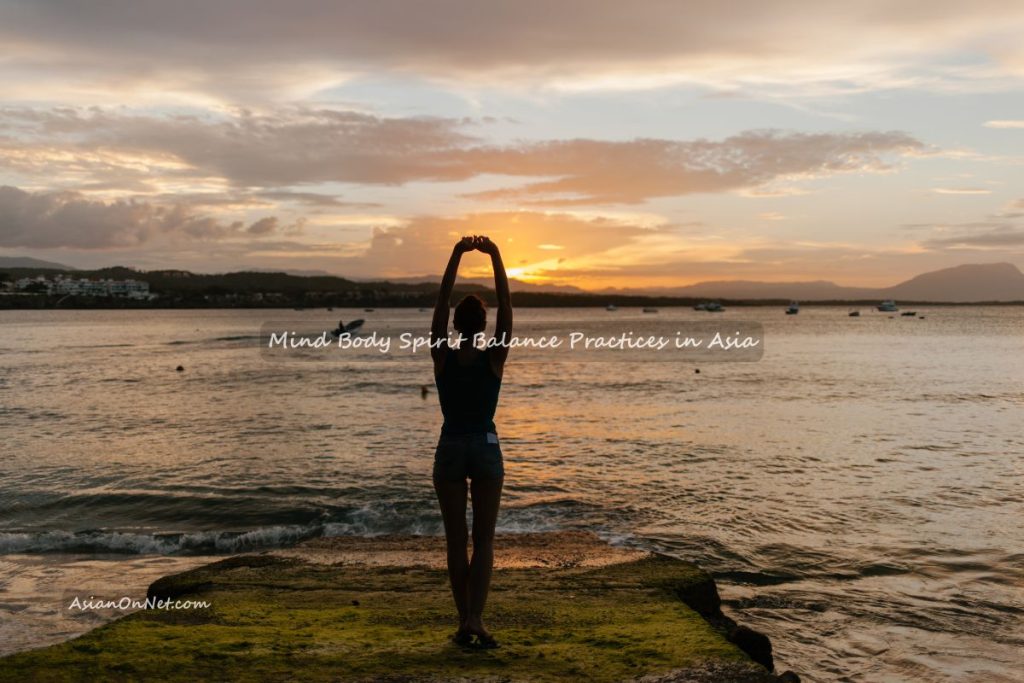
Such rituals are not mere tradition; they are living expressions of mind body spirit balance practices in Asia.
In recognizing the sacred in nature and self, mind body spirit balance practices in Asia foster a deep, enduring sense of belonging.
Regional Wisdom: A Pan-Asian Perspective
While unified by theme, mind body spirit balance practices in Asia vary beautifully across regions—each shaped by climate, history, and culture.
Let’s take a quick tour:
India: The Birthplace of Yoga and Ayurveda
In Kerala, Ayurvedic doctors diagnose patients by checking pulse, tongue, and digestion. Treatments include herbal oils, detox (Panchakarma), and personalized diets based on your dosha (Vata, Pitta, Kapha).
Yoga here isn’t just physical. It’s part of a dharma—a life path. Even in Mumbai’s chaos, you’ll find rooftop yoga studios and silent retreats in the Western Ghats.
China: The Flow of Qi
From acupuncture to herbal soups, Chinese medicine sees imbalance as blocked energy. Qigong and Tai Chi are prescribed for everything from insomnia to grief.
Daoist temples in places like Wudang Mountains still train martial monks in internal alchemy—using breath and movement to transform emotional energy.
Japan: Simplicity and Aesthetics
Zen gardens, haiku poetry, and the wabi-sabi aesthetic (beauty in imperfection) all reflect a culture that values stillness and subtlety.
Even in modern Japan, mind body spirit balance practices in Asia thrive through intentional rituals that honor presence and purity—like the tea ceremony, calligraphy, and seasonal festivals (matsuri).
Southeast Asia: Community and Devotion
In Thailand, morning alms-giving to monks reinforces generosity and humility. In Myanmar, thousands gather for mass meditation events.
In Bali, every village has a temple, and every full moon brings new ceremonies. Spirituality isn’t private—it’s communal.
From Ayurveda in Kerala to Daoist temples in Guangdong, mind body spirit balance practices in Asia continue to evolve without losing their essence.
Modern Life, Ancient Wisdom: Integrating Balance Today
We don’t need to move to a monastery or give up our smartphones to benefit from these traditions.
The beauty of mind body spirit balance practices in Asia is their adaptability. You don’t have to renounce the world to find peace in it.
Here’s how to weave them into modern life:
- Start small: 5 minutes of mindful breathing each morning.
- Move with intention: Replace gym guilt with Tai Chi or gentle yoga.
- Eat with awareness: Follow Ayurvedic principles by eating warm, seasonal foods.
- Create micro-rituals: Light a candle, say a gratitude phrase, walk barefoot on grass.
- Unplug to reconnect: Try a digital detox weekend—or even one evening.
In our hyperconnected world, the timeless value of mind body spirit balance practices in Asia offers a sanctuary of calm and coherence.
Urban wellness centers now adapt mind body spirit balance practices in Asia into weekend retreats and corporate mindfulness programs. Google, Apple, and Nike offer meditation rooms. Schools teach breathing techniques.
The ancient has become the avant-garde.
Conclusion: Embracing Wholeness in Daily Life
Balance isn’t a destination. It’s a dance.
It’s the breath before you speak in anger.
It’s the pause between emails.
It’s the choice to walk in the park instead of scrolling.
Across centuries and civilizations, mind body spirit balance practices in Asia have offered a compass for living well—not perfectly, but meaningfully.
They remind us that we are not machines to be optimized, but living beings to be nurtured.
So the next time you feel overwhelmed, ask yourself:
What would a monk do?
What would a Balinese grandmother offer?
What would my breath say, if I finally listened?
Because in the end, the art of living well may lie in returning to the wisdom of mind body spirit balance practices in Asia—where balance is not achieved, but lived.
And perhaps, like that temple bell in Kyoto, all it takes is one clear ring to bring you back to yourself.
Frequently Asked Questions (FAQ)
Q: What are mind body spirit balance practices in Asia?
A: Mind body spirit balance practices in Asia include meditation, yoga, Tai Chi, Qigong, Ayurveda, and mindfulness rituals that harmonize mental, physical, and spiritual health through centuries-old traditions.
Q: How do mind body spirit balance practices in Asia differ from Western wellness?
A: Unlike Western models that often treat symptoms, mind body spirit balance practices in Asia emphasize prevention, inner harmony, and the interconnectedness of nature, lifestyle, and consciousness.
Q: Can beginners benefit from mind body spirit balance practices in Asia?
A: Absolutely. Practices like mindful breathing, gentle yoga, or daily gratitude—rooted in mind body spirit balance practices in Asia—are accessible to all levels and require no prior experience.
Q: Which countries have the most influential mind body spirit balance practices in Asia?
A: India (yoga, Ayurveda), China (Tai Chi, Qigong), Japan (Zen, forest bathing), and Southeast Asian nations like Thailand and Bali are key centers of mind body spirit balance practices in Asia.
Q: How can I incorporate mind body spirit balance practices in Asia into a busy schedule?
A: Start small—5 minutes of meditation, mindful walking, or morning stretching. These simple acts are core to mind body spirit balance practices in Asia and can transform your day.