








- Introduction
- Traditional Crafts Depend On Living Knowledge
- Artisans Are The Main Carriers Of Craft Knowledge
- Family Traditions Still Matter
- Young People May Choose Different Careers
- Apprenticeships Transfer More Than Technique
- Learning Takes Time
- Master Artisans Play A Special Role
- Documentation Can Support Teaching
- Community Workshops Can Keep Skills Visible
- Cooperatives Can Support Craft Livelihoods
- Craft Schools Can Create New Pathways
- Schools Can Introduce Children To Local Crafts
- Local Materials Are Part Of Craft Knowledge
- Environmental Change Can Affect Craft Traditions
- Traditional Does Not Mean Unchanging
- New Designs Can Keep Old Skills Relevant
- But Simplification Can Also Reduce Skills
- Tourism Can Support Artisans
- Tourism Can Also Change What Is Produced
- Customers Influence What Survives
- Handmade Work Takes Time
- Fair Pricing Matters
- Digital Platforms Can Reach New Customers
- Storytelling Can Increase Appreciation
- Online Markets Also Bring Challenges
- Younger Generations Can Contribute Without Becoming Full-Time Artisans
- Collaboration With Designers Can Create New Markets
- Artisan Credit Matters
- Cultural Meaning Should Not Be Lost
- Museums Can Preserve Objects And Knowledge
- Craft Demonstrations Keep The Maker Visible
- Festivals Can Create Public Interest
- Cultural Recognition Can Raise Status
- Preservation Should Not Freeze Artisans In The Past
- Craft Communities Need Economic Choice
- Women Often Play Important Roles In Craft Transmission
- Older Artisans Need Opportunities To Teach
- Younger Learners Need Reasons To Stay
- Craft Preservation Can Support Local Identity
- Not Every Craft Needs Mass Growth
- Quality Can Matter More Than Quantity
- Consumers Can Ask Better Questions
- Workshops Can Create Respect For Skill
- Documentation Should Include Artisan Voices
- Craft Knowledge Can Change Across Generations
- Communities Should Help Define What Preservation Means
- Common Threats To Traditional Craft Skills
- What Helps Keep Craft Skills Alive?
- How Travellers Can Support Traditional Crafts
- Avoid Treating Artisans As Attractions
- The Future Of Traditional Crafts Across Asia
- Conclusion
- FAQ
- What Is Traditional Craft Preservation In Asia?
- Why Are Apprenticeships Important For Traditional Crafts?
- Why Are Some Traditional Craft Skills Disappearing?
- Can Traditional Crafts Change And Still Be Authentic?
- How Does Tourism Affect Traditional Crafts?
- Can Online Selling Help Traditional Artisans?
- Why Does Fair Pricing Matter?
- How Can Younger Generations Help Preserve Craft Traditions?
- How Can Travellers Support Traditional Artisans?
- What Is The Most Important Part Of Traditional Craft Preservation In Asia?
Introduction
Traditional crafts survive because people continue to practise them.
A weaving technique, carving method, dyeing process, pottery style, metalworking skill, embroidery tradition, or handmade paper technique cannot be preserved only by placing finished objects in a museum.
Someone must still know how to make them.
That makes traditional craft preservation in Asia fundamentally a story about people, knowledge, time, and transmission between generations.
Across Asia, traditional skills are maintained in many different ways. Some remain within families. Others are taught through apprenticeships, community workshops, cooperatives, schools, cultural organisations, or relationships between master artisans and younger makers.
At the same time, craft communities are changing.
Young people may move to cities. Handmade products may compete with inexpensive factory-made alternatives. Traditional materials may become harder to obtain. Tourism can create new markets but can also encourage faster production or simplified designs.
Digital platforms can introduce artisans to global customers, while changing consumer tastes may encourage traditional skills to be used in completely new products.
Understanding traditional craft preservation in Asia therefore requires looking beyond the objects themselves.
The central question is:
How do people keep the knowledge of making them alive?
👉 “Readers exploring traditional crafts across Asia may also enjoy these family-friendly shopping and food options in Bangkok malls for a more modern retail experience.”
Traditional Crafts Depend On Living Knowledge
A finished craft object shows the result.
It does not necessarily show everything required to create it.
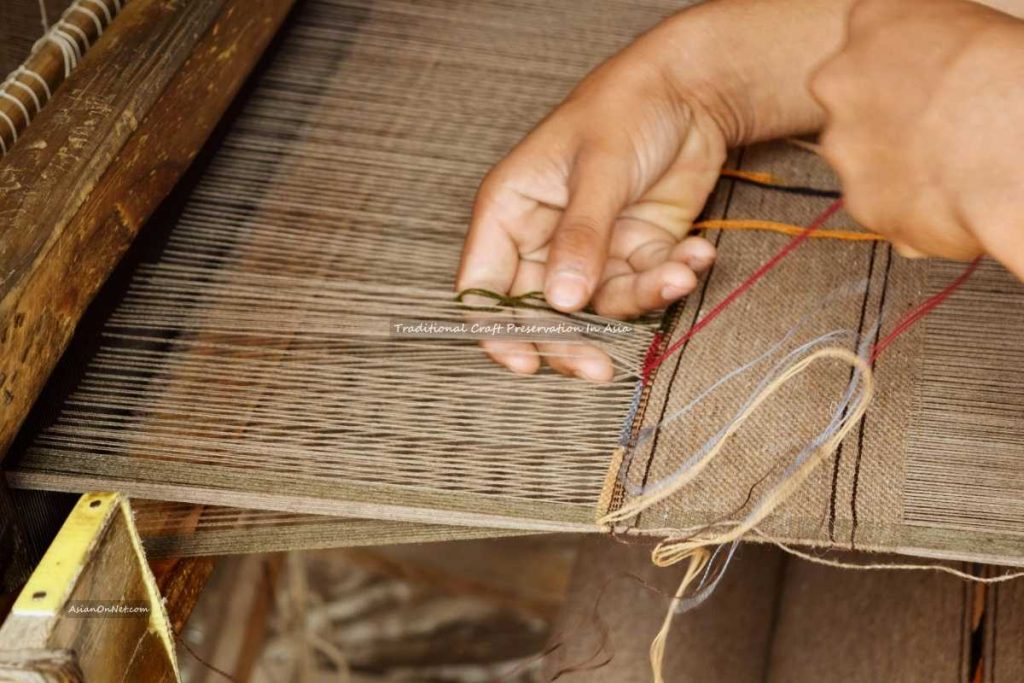
An experienced artisan may understand:
- How to select raw materials
- How weather affects production
- How much pressure to apply
- When a dye has reached the right colour
- How long something should dry
- How to repair a mistake
- Which tools work best
- How a pattern should be interpreted
Some of this knowledge can be written down.
Much of it is learned through observation and repeated practice.
This is one reason traditional craft preservation in Asia depends so heavily on direct knowledge transfer.
A photograph can preserve the appearance of an object.
A video can document a process.
But neither automatically creates a skilled artisan.
Artisans Are The Main Carriers Of Craft Knowledge
Traditional crafts remain alive because artisans continue making them.
Experienced makers may carry decades of practical knowledge that is difficult to capture completely in manuals.
They know not only the formal steps but also the small adjustments that come from experience.
For example, an artisan may recognise by touch when a material is ready.
Another may judge colour without measuring it.
A craftsperson may change technique depending on humidity, wood quality, fibre strength, or the behaviour of a kiln.
These practical decisions are central to traditional craft preservation in Asia because traditional knowledge often exists partly in the hands, eyes, and judgement of the maker.
Family Traditions Still Matter
In many craft communities, skills historically passed from parents to children or between other relatives.
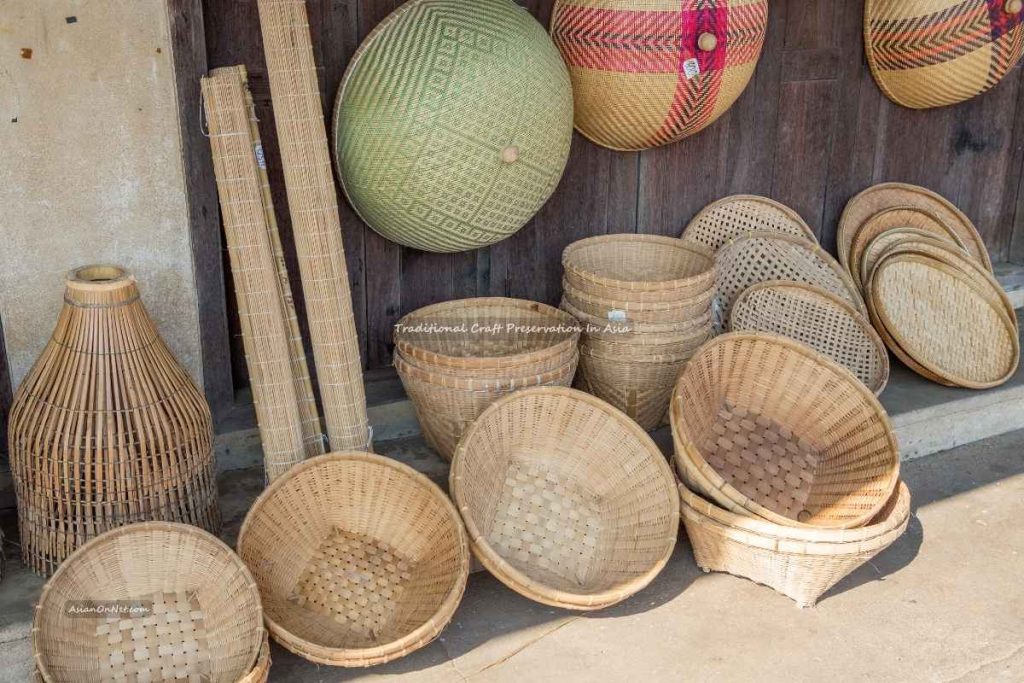
Children might grow up watching family members:
- Weave
- Carve
- Dye cloth
- Shape clay
- Embroider
- Work metal
- Prepare natural materials
Learning could begin informally.
A child might first help prepare materials, clean tools, sort fibres, or observe simple tasks.
More difficult techniques would come later.
Family transmission remains an important part of traditional craft preservation in Asia, but it cannot always be assumed to continue automatically.
Younger generations may have very different opportunities and ambitions from their parents.
Young People May Choose Different Careers
Traditional craft work can require enormous skill while producing uncertain income.
Younger family members may prefer careers offering:
- More predictable salaries
- Shorter working hours
- Urban opportunities
- Greater social status
- Less physical work
This can create a difficult situation.
Parents may want children to have wider opportunities, even if that means the family craft tradition ends.
Successful traditional craft preservation in Asia therefore cannot depend only on telling younger people that they have a cultural responsibility to continue.
Craft work also needs to offer a realistic future.
Apprenticeships Transfer More Than Technique
Apprenticeships can help preserve knowledge outside the immediate family.
A younger maker works directly with someone more experienced and gradually learns the craft through practice.
This may include:
- Tool handling
- Material preparation
- Technique
- Design principles
- Quality standards
- Problem solving
- Local terminology
The apprentice may also learn why certain methods are used.
That deeper understanding matters.
If someone only memorises steps, they may struggle when materials or conditions change.
Apprenticeships strengthen traditional craft preservation in Asia because they transfer both practical technique and the reasoning behind it.
Learning Takes Time
Traditional skills are sometimes presented to visitors through short workshops.
These experiences can be useful introductions, but they are very different from becoming an accomplished artisan.
A visitor may learn to make a small object in an afternoon.
A skilled craftsperson may have practised for years.
This distinction is important when discussing traditional craft preservation in Asia.
Complex skills cannot always be reduced to quick demonstrations.
Real preservation requires people who have enough time to develop mastery.
Master Artisans Play A Special Role
Some craft traditions depend heavily on highly experienced makers.
These master artisans may understand techniques that few others still practise.
Their role can include:
- Teaching
- Demonstrating
- Correcting mistakes
- Reconstructing older methods
- Maintaining quality standards
- Interpreting traditional patterns
When only a small number of people retain specialised knowledge, the risk of losing that knowledge becomes greater.
Supporting master artisans as teachers can therefore be an important part of traditional craft preservation in Asia.
Documentation Can Support Teaching
Not every traditional technique has been formally documented.
Recording knowledge can help future learners.
Useful documentation may include:
- Photographs
- Video
- Drawings
- Pattern records
- Tool descriptions
- Interviews
- Material information
- Local terminology
Documentation should ideally happen while skilled practitioners are still available to explain what they are doing.
However, documentation works best as support rather than a replacement for practice.
A recorded weaving technique becomes much more valuable when a learner can also work beside someone who understands it.
Community Workshops Can Keep Skills Visible
Craft traditions often survive more easily when knowledge is shared beyond a single household.
Community workshops may create spaces where:
- Experienced artisans teach
- Younger people practise
- Tools can be shared
- Materials can be purchased collectively
- Visitors can learn about the tradition
These spaces can strengthen traditional craft preservation in Asia by turning craft from an isolated activity into a visible community practice.
They may also help artisans learn from each other.
Cooperatives Can Support Craft Livelihoods
One of the biggest challenges in preserving traditional skills is economic sustainability.
Artisans need customers.
Cooperatives can sometimes help by sharing tasks such as:
- Marketing
- Purchasing materials
- Packaging
- Selling
- Transport
- Training
This may allow artisans to spend more time making while reducing some of the business burden.
For traditional craft preservation in Asia, economic organisation can be just as important as cultural appreciation.
A craft that people admire but nobody can afford to practise professionally remains vulnerable.
Craft Schools Can Create New Pathways
Some traditional skills are now taught through:
- Vocational schools
- Art schools
- Cultural centres
- Community programmes
- Specialist workshops
Formal teaching can help open craft traditions to people who were not born into artisan families.
That can widen the pool of future practitioners.
At the same time, classroom teaching works best when experienced craftspeople remain involved.
Traditional skills often depend on practical knowledge that is difficult to learn from theory alone.
Schools Can Introduce Children To Local Crafts
Not every child who learns a traditional craft needs to become a professional artisan.
School programmes can still help children understand:
- Local materials
- Craft history
- Design
- Cultural meaning
- Manual skills
Early exposure may create respect for local traditions.
Some students may later return to the craft as adults.
This broader awareness contributes to traditional craft preservation in Asia even when only a small percentage become full-time makers.
Local Materials Are Part Of Craft Knowledge
Traditional crafts are often closely connected with local natural resources.
Artisans may use:
- Wood
- Bamboo
- Clay
- Silk
- Cotton
- Plant fibres
- Natural dyes
- Metals
- Paper materials
Knowing how to select and prepare these materials can be a craft skill in itself.
If traditional materials disappear or become expensive, the craft may change.
This makes access to materials another important part of traditional craft preservation in Asia.
Environmental Change Can Affect Craft Traditions
Crafts do not exist separately from the environment.
Changes in:
- Agriculture
- Forestry
- Water
- Climate
- Land use
- Local ecosystems
can influence the availability or quality of traditional materials.
Artisans may need to:
- Find alternative suppliers
- Grow materials themselves
- Modify techniques
- Experiment with substitutes
Preserving a technique sometimes requires adapting the material system around it.
Traditional Does Not Mean Unchanging
A common misconception is that preserving a craft means making exactly the same objects forever.
Historically, artisans have often adapted.
They respond to:
- New materials
- New customers
- New tools
- Changing fashions
- New trade routes
- Different household needs
For traditional craft preservation in Asia, change is not automatically a threat.
The more useful question is whether the core knowledge and skill remain meaningful within the new form.
New Designs Can Keep Old Skills Relevant
A traditional weaving method might be used for:
- Bags
- Contemporary clothing
- Interior textiles
- Accessories
A carving tradition may appear in modern decorative objects.
A handmade paper technique might be used for stationery or design products.
These adaptations can create new markets while maintaining important technical knowledge.
Successful traditional craft preservation in Asia often involves balancing continuity with innovation.
But Simplification Can Also Reduce Skills
Market demand can sometimes push crafts in the opposite direction.
Visitors may prefer:
- Cheaper products
- Smaller products
- Faster production
- Easily transported souvenirs
Artisans may respond by simplifying:
- Patterns
- Materials
- Techniques
- Finishing
This is not automatically wrong.
Artisans need to earn a living.
But if simplified production becomes the only production, complex skills may gradually disappear.
Tourism Can Support Artisans
Tourism can create direct demand for handmade goods.
Visitors may:
- Purchase crafts
- Visit workshops
- Attend demonstrations
- Join introductory classes
- Learn about local traditions
This can provide income and make craft communities more visible.
Tourism can therefore contribute positively to traditional craft preservation in Asia when it supports genuine artisan work.
Tourism Can Also Change What Is Produced
Tourist markets may encourage crafts that are:
- Small
- Lightweight
- Decorative
- Inexpensive
- Easy to understand quickly
Traditional objects created for local households may not fit those expectations.
As a result, artisans may change designs.
The challenge is not necessarily preventing change.
It is making sure that market adaptation does not remove the knowledge that made the tradition distinctive.
Customers Influence What Survives
Craft preservation is not only the responsibility of artisans.
Buyers influence production.
If customers choose only the cheapest handmade-looking object, artisans have little incentive to spend days producing technically demanding work.
People interested in traditional craft preservation in Asia can support artisans by learning about:
- Materials
- Labour
- Production time
- Technique
- Artisan identity
Understanding why an object costs more can change purchasing decisions.
Handmade Work Takes Time
Industrial production has changed consumer expectations.
People are accustomed to products being:
- Cheap
- Identical
- Quickly available
Traditional handmade production operates differently.
Minor variation may be normal.
Production may take days or weeks.
Materials may be prepared by hand.
Accepting these realities is part of respecting craft traditions.
Fair Pricing Matters
A traditional craft cannot remain economically sustainable if artisans are consistently paid too little.
Prices need to reflect more than the raw materials.
They may also represent:
- Years of training
- Labour
- Tool costs
- Design knowledge
- Material preparation
- Finishing
Fairer markets can strengthen traditional craft preservation in Asia by making continued practice financially possible.
Digital Platforms Can Reach New Customers
Artisans no longer need to depend entirely on nearby markets.
Digital tools can connect craft producers with:
- National customers
- International customers
- Designers
- Collectors
- Cultural organisations
Social media can show the process behind a craft rather than only the finished object.
This can be particularly useful because the making process often explains why handmade work has value.
Storytelling Can Increase Appreciation
A photograph of a finished textile may be attractive.
A short explanation showing:
- Who made it
- Where the technique comes from
- How fibres are prepared
- How long weaving takes
can give the buyer much more context.
Digital storytelling can therefore support traditional craft preservation in Asia by helping customers understand the human knowledge behind an object.
Online Markets Also Bring Challenges
Digital selling is not automatically easy for artisans.
Challenges may include:
- Photography
- Language
- Shipping
- Payment systems
- Platform fees
- Customer communication
Older artisans may also have little interest in managing online shops.
Support from younger family members, cooperatives, designers, or local organisations can help bridge this gap.
Younger Generations Can Contribute Without Becoming Full-Time Artisans
A young person may not want to weave, carve, or make pottery every day.
They can still support a family craft tradition through:
- Photography
- Social media
- Website management
- Packaging
- Translation
- Customer communication
- Design
This creates another model for traditional craft preservation in Asia.
Preservation does not always require every family member to perform the same role as previous generations.
Collaboration With Designers Can Create New Markets
Traditional artisans and contemporary designers sometimes work together.
This can introduce:
- New forms
- New colour combinations
- New product uses
- New customer groups
When handled respectfully, collaboration can help craft skills remain economically relevant.
However, collaboration should recognise the artisan’s contribution rather than treating traditional knowledge as a free source of design ideas.
Artisan Credit Matters
Traditional designs are sometimes marketed without identifying the people or communities that created them.
Better recognition can help customers understand that craft knowledge belongs to living communities.
Credit may include:
- Artisan name
- Village or region
- Technique
- Cultural background where appropriate
Recognition is an important part of traditional craft preservation in Asia because it keeps the maker visible.
Cultural Meaning Should Not Be Lost
Some patterns, colours, forms, or objects may have cultural meanings beyond decoration.
They may be connected with:
- Ceremonies
- Family identity
- Religion
- Community status
- Local history
Not every design should automatically be separated from that context.
Artisans and communities themselves are best positioned to explain what can appropriately be adapted or commercialised.
Museums Can Preserve Objects And Knowledge
Museums play an important role in cultural preservation.
They can collect:
- Historic examples
- Tools
- Patterns
- Photographs
- Documents
They may also host:
- Artisan demonstrations
- Workshops
- Talks
- Exhibitions
Museums contribute to traditional craft preservation in Asia when they connect historical collections with living practitioners.
Otherwise, visitors may incorrectly assume a craft belongs only to the past.
Craft Demonstrations Keep The Maker Visible
Watching an artisan work can transform how people understand an object.
A bowl that looked simple may suddenly appear very different after seeing:
- Material preparation
- Shaping
- Drying
- Decoration
- Finishing
Demonstrations reveal the labour hidden inside the finished product.
They can also create opportunities for artisans to explain their own traditions.
Festivals Can Create Public Interest
Craft fairs and cultural festivals can bring artisans together with wider audiences.
They may help with:
- Sales
- Demonstrations
- Teaching
- Networking
- Public awareness
For younger visitors, a festival may be their first encounter with a local craft tradition.
Visibility can support traditional craft preservation in Asia by reminding communities that traditional knowledge still has contemporary value.
Cultural Recognition Can Raise Status
A major challenge for some craft communities is that handmade work may be viewed as old-fashioned or low status.
Public recognition can change that perception.
Awards, exhibitions, cultural programmes, and media attention can show that craft skill represents:
- Expertise
- Creativity
- History
- Technical knowledge
Higher social recognition may make craft careers more attractive to younger people.
Preservation Should Not Freeze Artisans In The Past
Artisans are contemporary people.
They use smartphones, follow trends, experiment with design, and make business decisions.
Expecting them to reproduce the past exactly can be limiting.
Healthy traditional craft preservation in Asia allows artisans to innovate while retaining control over their knowledge and work.
Preservation should support living traditions, not turn makers into museum exhibits.
Craft Communities Need Economic Choice
An artisan should be able to decide whether to:
- Continue traditional designs
- Create contemporary work
- Teach
- Sell locally
- Sell internationally
- Work part time
Preservation works better when artisans have options.
A craft maintained only because people have no alternative livelihood is not necessarily a strong preservation model.
Women Often Play Important Roles In Craft Transmission
In many communities, women have historically maintained skills related to:
- Weaving
- Embroidery
- Basketry
- Textile preparation
- Dyeing
These skills may have been practised alongside farming, childcare, and household work.
Recognising their contribution is important when documenting traditional craft preservation in Asia.
Craft history should not focus only on highly visible professional workshops while overlooking domestic knowledge.
Older Artisans Need Opportunities To Teach
When experienced makers retire without passing on their knowledge, techniques may disappear.
Teaching programmes can create structured opportunities for older artisans to work with younger learners.
This may involve:
- Apprenticeships
- Community classes
- School visits
- Demonstrations
- Recorded interviews
Such programmes can also recognise the artisan’s knowledge as valuable expertise.
Younger Learners Need Reasons To Stay
Teaching alone is not enough.
Young people may learn a craft but abandon it if there is no viable income.
For traditional craft preservation in Asia, training should ideally connect with:
- Business skills
- Marketing
- Design
- Customer access
- Fair pricing
Cultural preservation and economic sustainability need to work together.
Craft Preservation Can Support Local Identity
Traditional crafts can communicate something about place.
Local materials, patterns, forms, and techniques may reflect:
- Geography
- History
- Religion
- Trade
- Local aesthetics
When craft knowledge disappears, communities may lose more than a production technique.
They may lose part of how local history is expressed.
This gives traditional craft preservation in Asia cultural importance beyond the craft market itself.
Not Every Craft Needs Mass Growth
Success does not always mean producing more.
Some highly specialised crafts may remain:
- Small scale
- Expensive
- Slow
- Limited in production
That can be appropriate.
The goal of preservation is not necessarily turning every craft into a large industry.
Sometimes the priority is ensuring enough skilled practitioners remain to keep the knowledge alive.
Quality Can Matter More Than Quantity
If demand grows too quickly, artisans may struggle to maintain traditional standards.
Expansion can lead to:
- Faster methods
- Cheaper materials
- Outsourcing
- Reduced finishing
Growth needs to be balanced carefully.
For some traditions, producing fewer high-quality objects may support traditional craft preservation in Asia better than rapid commercial expansion.
Consumers Can Ask Better Questions
People buying handmade crafts can ask:
- Who made this?
- Where was it made?
- What material was used?
- How was it produced?
- Is the artisan identified?
- Is it genuinely handmade?
These questions encourage transparency.
They also help consumers distinguish between authentic artisan work and factory-made products marketed with traditional imagery.
Workshops Can Create Respect For Skill
Participating in a craft workshop can help visitors understand how difficult traditional techniques actually are.
Trying to:
- Weave a simple pattern
- Shape clay evenly
- Carve a small design
- Prepare natural dye
often creates immediate appreciation for experienced artisans.
Workshops can therefore support traditional craft preservation in Asia even when participants never become serious practitioners.
Documentation Should Include Artisan Voices
Cultural documentation is stronger when artisans explain their own work.
Instead of only recording:
“This technique uses bamboo,”
researchers can ask:
- How did you learn?
- Who taught you?
- What has changed?
- Which part is most difficult?
- Why is this design important?
- What do younger people think about the craft?
These stories reveal how preservation actually happens.
Craft Knowledge Can Change Across Generations
A younger artisan may learn a traditional method and then modify it.
The next generation may make another change.
This does not necessarily mean the craft has been lost.
Living traditions evolve.
The challenge for traditional craft preservation in Asia is identifying which techniques, meanings, and knowledge are essential enough that losing them would fundamentally change the tradition.
Communities Should Help Define What Preservation Means
Outside organisations may want to protect a traditional craft.
But preservation decisions should involve the people who practise it.
Communities may have different priorities.
They may want to:
- Protect a specific technique
- Improve income
- Teach younger people
- Change outdated products
- Maintain ceremonial designs
- Develop new markets
Effective preservation should reflect those priorities.
Common Threats To Traditional Craft Skills
Several challenges can weaken craft traditions.
Fewer Apprentices
Without learners, knowledge may disappear.
Low Income
Skilled makers may leave craft work for more secure employment.
Cheap Imitations
Factory-made alternatives can reduce demand for genuine handmade work.
Loss Of Materials
Environmental or economic changes may affect traditional resources.
Migration
Young people may move away from craft-producing communities.
Simplification
Market pressure may remove difficult techniques.
Lack Of Documentation
Rare knowledge can disappear when an experienced artisan dies or retires.
Addressing these challenges is central to traditional craft preservation in Asia.
What Helps Keep Craft Skills Alive?
Strong preservation usually combines several approaches.
Skilled Teachers
Experienced artisans need opportunities to pass on knowledge.
Motivated Learners
Younger people need access to meaningful training.
Economic Opportunity
Craft must offer a realistic way to earn income.
Market Access
Artisans need customers who understand handmade value.
Documentation
Rare techniques should be recorded.
Community Support
Local people need reasons to value the tradition.
Adaptation
Artisans should have room to create contemporary work.
Together, these elements make traditional craft preservation in Asia more sustainable.
How Travellers Can Support Traditional Crafts
Visitors can contribute in simple ways.
Buy directly from artisans when practical.
Ask about the process.
Attend respectful workshops.
Pay prices that recognise skilled labour.
Avoid assuming handmade products should always be cheap simply because they are made in a rural community.
Travellers can also look beyond souvenirs.
A workshop visit can reveal much more about a culture than simply purchasing an object.
Avoid Treating Artisans As Attractions
Visitors should remember that workshops are workplaces.
Ask before:
- Photographing people
- Photographing detailed techniques
- Entering work areas
- Handling objects
Respecting the maker is part of supporting the tradition.
Cultural interest should not remove an artisan’s right to privacy or control over their work.
The Future Of Traditional Crafts Across Asia
The future will probably not look exactly like the past.
Some crafts will become smaller.
Others may find international markets.
Traditional patterns may appear in contemporary fashion.
Young artisans may sell through social media rather than village markets.
Digital tools may document techniques that were once transmitted only orally.
These changes do not automatically weaken traditional craft preservation in Asia.
The key issue is whether people still possess the knowledge required to make, teach, interpret, and adapt the craft.
As long as that knowledge remains alive, a tradition can continue evolving.
👉 “Readers interested in traditional crafts and regional products may also explore these Bangkok shopping malls for food and family-friendly experiences for more modern shopping ideas.”
Conclusion
Traditional craft preservation in Asia depends on much more than protecting beautiful objects.
It depends on protecting the knowledge required to make them.
Artisans remain at the centre of that process.
Their experience includes techniques, material knowledge, judgement, local terminology, design understanding, and practical skills that may take years to develop.
Families have traditionally played a major role in transferring this knowledge, but family transmission alone may no longer be enough.
Apprenticeships, schools, community workshops, museums, cultural programmes, cooperatives, and documentation can all support traditional craft preservation in Asia.
Economic sustainability is equally important.
Young people are more likely to continue craft traditions when those traditions offer realistic opportunities for income, creativity, and professional development.
Tourism can provide useful markets, but it can also encourage faster and simpler products. Digital platforms can connect artisans with new customers, but they also require new skills in marketing, photography, shipping, and communication.
Innovation should not automatically be treated as a threat.
Traditional crafts have changed throughout history.
New products, modern designs, and collaborations can help skills remain relevant as long as the knowledge and contribution of artisans are respected.
Consumers also play a role in traditional craft preservation in Asia.
Understanding the time, skill, materials, and experience behind handmade work can encourage fairer purchasing decisions.
Ultimately, keeping traditional crafts alive means keeping people involved.
Someone must learn.
Someone must teach.
Someone must continue practising.
And enough people must value that knowledge for the tradition to have a future.
That is the real foundation of traditional craft preservation in Asia: not simply preserving what was made yesterday, but ensuring that people still know how to make, understand, and develop it tomorrow.
FAQ
What Is Traditional Craft Preservation In Asia?
Traditional craft preservation in Asia is the process of keeping traditional making skills, knowledge, techniques, materials, and cultural meanings alive through artisans, teaching, apprenticeships, documentation, community support, and sustainable markets.
Why Are Apprenticeships Important For Traditional Crafts?
Apprenticeships allow learners to observe experienced artisans directly and practise techniques over time. They can transfer practical knowledge that is difficult to communicate through books or videos alone.
Why Are Some Traditional Craft Skills Disappearing?
Common reasons include low income, fewer apprentices, migration, competition from factory-made products, loss of traditional materials, and changing consumer demand.
Can Traditional Crafts Change And Still Be Authentic?
Yes. Craft traditions have always evolved. New products and designs can help a tradition remain relevant as long as important skills, knowledge, and cultural context are respected.
How Does Tourism Affect Traditional Crafts?
Tourism can provide income and greater visibility for artisans, but it can also encourage cheaper, faster, or simplified products. The effect depends on how tourism markets develop.
Can Online Selling Help Traditional Artisans?
Yes. Digital marketplaces and social media can help artisans reach customers beyond their local communities. However, online selling also requires skills such as photography, communication, payment management, and shipping.
Why Does Fair Pricing Matter?
Traditional handmade work may require years of training and many hours of labour. Fair pricing can make craft work economically sustainable and encourage skilled artisans to continue practising.
How Can Younger Generations Help Preserve Craft Traditions?
Young people can learn the craft directly or support family traditions through design, marketing, photography, digital sales, translation, and other modern business skills.
How Can Travellers Support Traditional Artisans?
Travellers can buy directly from makers when possible, ask about production methods, attend respectful workshops, pay fair prices, and avoid treating skilled artisans simply as tourist attractions.
What Is The Most Important Part Of Traditional Craft Preservation In Asia?
The most important part of traditional craft preservation in Asia is continued knowledge transfer. Finished objects can be stored and displayed, but a living craft survives only when people still know how to make it and can pass those skills to future generations.